How to Support Prostate Health After 40: A Practical Guide
| The idea | The prostate changes naturally with age — support it with steady everyday habits, not last-minute fixes. |
| Foundations | Hydration, regular movement, a healthy weight, a vegetable-rich diet and good bathroom habits. |
| Botanicals men use | Saw palmetto, pygeum africanum, pumpkin seed, stinging nettle and tomato lycopene. |
| Best approach | Pick a simple routine you can keep to consistently, and check in with your doctor. |
Somewhere around 40, a lot of men start thinking about their prostate for the first time — often because a friend mentioned it, or because a routine check-up brought it up. The good news is that supporting normal prostate health is far less complicated than the internet makes it sound. It comes down to a handful of sensible everyday habits, a few plant-based ingredients men have leaned on for generations, and the discipline to keep to a routine rather than chase quick fixes.
This guide walks through what actually matters, in plain language. It is general educational information, not medical advice — but it should give you a clear, realistic starting point.
Why the prostate deserves attention after 40
The prostate is a small, walnut-sized gland that sits just below the bladder. It grows slowly throughout adult life, and it is completely normal for it to change gradually as the decades pass. Because of where it sits, those changes can eventually affect everyday comfort and daily routine for some men, which is exactly why a little proactive attention pays off.
Two things tend to line up as men get older: daily diets narrow, and the body becomes a little less efficient at absorbing and using certain nutrients. Neither is cause for alarm — but together they explain why building a supportive routine before you feel you need one is smarter than waiting. Think of it the way you already think about your heart or your teeth: everyday maintenance, not emergency repair.
Start with the everyday basics
Before any supplement, the foundations do the heavy lifting. None of these are dramatic, and that is the point — they are the boring habits that quietly add up.
- ✓ Stay hydrated, but time it. Drink water steadily through the day and ease off in the couple of hours before bed so your sleep is not interrupted.
- ✓ Move most days. Regular walking and general activity support healthy circulation, a healthy weight and overall wellbeing.
- ✓ Mind your weight. Keeping to a healthy weight is one of the most widely recommended habits for men’s health in general.
- ✓ Eat the rainbow. Plenty of vegetables, tomatoes, healthy fats, nuts and seeds give your body the raw materials it works with.
- ✓ Go easy on the extras. Moderating alcohol and heavy caffeine can make a real difference to everyday comfort.
- ✓ Don’t hold on. Answer nature’s call rather than holding urine for long stretches out of habit.
If you do nothing else, do these. A supplement is designed to sit on top of good habits, not to replace them.
The plant-based botanicals men reach for
Long before modern supplements, men across many cultures used specific plants as part of their wellness routines. A handful of these show up again and again in prostate-focused formulas because of their traditional reputation. Here is a quick, honest tour — described by their traditional and general use, not as cures for anything.
Saw palmetto (Serenoa repens). The best known of the group. The berries of this small palm have a long history of traditional use in men’s prostate and urinary wellness routines, and it remains the botanical most men have heard of first.
Pygeum africanum (Prunus africana). An African tree-bark extract traditionally paired with saw palmetto. It has been used for generations in men’s formulas aimed at everyday comfort.
Pumpkin seed (Cucurbita pepo). Rich in plant compounds and zinc-friendly nutrients, pumpkin seed is a long-standing, food-based addition to men’s wellness blends — and an easy one to add to your diet directly, too.
Stinging nettle (Urtica dioica). The root has a traditional place in European men’s-health folk practice and is a common companion to saw palmetto and pygeum in modern blends.
Lycopene from tomato. The natural red carotenoid that gives tomatoes their colour is valued as an antioxidant and appears frequently in prostate-focused formulas. Cooked tomatoes are a particularly good dietary source.
You can get several of these from food. A well-made supplement simply brings them together in consistent daily amounts so you are not relying on hitting the right foods every single day.
Want all five in one daily capsule?
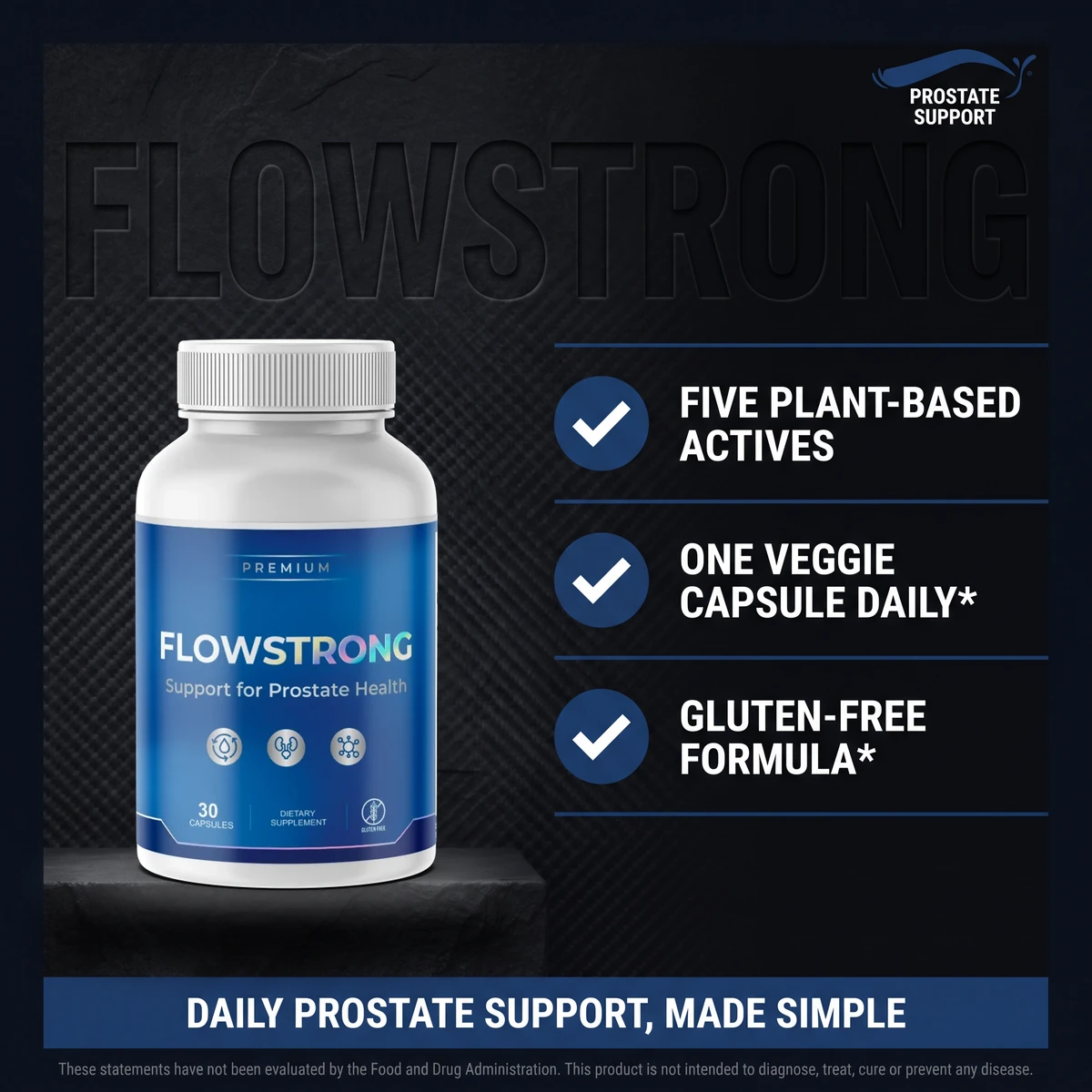
Flow Strong™ brings saw palmetto, pygeum, pumpkin seed, stinging nettle and tomato lycopene together in a single, once-daily plant-based veggie capsule — backed by a 60-day money-back guarantee.
See Flow Strong PackagesHow to build a routine you’ll actually keep
The single biggest reason supportive routines fail is not the ingredients — it is consistency. Botanicals are traditionally used gradually and steadily, so the men who get the most out of them are simply the ones who remember to take them. A few practical tips:
- ✓ Anchor it to an existing habit. Take your capsule with your morning coffee or alongside brushing your teeth so it piggybacks on something you already do.
- ✓ Keep it visible. A bottle left by the kettle or your keys gets taken; a bottle in a cupboard gets forgotten.
- ✓ Choose “once a day” over complicated. The simpler the routine, the higher the odds you stick with it for the long haul.
- ✓ Give it a fair trial. Judge a routine over several weeks to a few months of uninterrupted use, not over a few days.
- ✓ Don’t stack up on empty. Order enough that you never run out mid-routine — a gap resets your consistency.
This is exactly the thinking behind a once-daily format: fewer moving parts, fewer reasons to skip it. If a routine is easy, it survives busy weeks — and busy weeks are when good habits usually slip.
When to talk to your doctor
Supplements and good habits are for general, everyday support — they are not a substitute for medical care. See a healthcare professional if you notice persistent changes in urination, ongoing discomfort, blood where it should not be, or any symptom that worries you. It is also worth asking your doctor about age-appropriate prostate screening, since recommendations depend on your age, family history and personal risk factors.
There is no downside to a conversation. A quick check-in gives you peace of mind and makes sure that anything worth catching early gets caught early. Think of your daily routine and your doctor as working on the same team.
The bottom line
Supporting prostate health after 40 is not about a single miracle product. It is about stacking sensible habits — hydration, movement, a healthy weight and a vegetable-rich diet — and then, if you choose, adding a simple, consistent supplement built on the plant-based ingredients men have trusted for generations. Keep it easy, keep it regular, and keep your doctor in the loop. That is a routine you can carry for decades, not weeks.
The habit with the best evidence behind it
If you only change one thing after 40, make it movement rather than a bottle. An update on exercise and physical activity as modifiable risk factors for benign prostatic hyperplasia (Curr Urol Rep, 2026) found regular physical activity is among the small set of factors men can genuinely influence, and it sits alongside body weight, alcohol, caffeine and evening fluid intake as the levers with real evidence behind them. No supplement in this category has a comparable body of work behind it, and any page that implies otherwise has its priorities backwards.
That is not an argument against a daily capsule — it is an argument for the order of operations. Get the habits in place, then decide whether a supplement adds anything you want. Our independent guide to Flow Strong is one worked example of what that decision looks like when the evidence is laid out honestly. If you get that far, our buyer’s checklist on how to choose a prostate supplement keeps you out of the obvious traps, our comparison of lycopene and zinc covers the two nutrients men ask about most, and our look at pumpkin seed oil explains where a food-derived option fits.
And the line no supplement page should blur: urinary symptoms are a medical matter. Blood in your urine or semen, pain or burning when you pass urine, fever or chills alongside urinary symptoms, or any new or worsening change in how often or how urgently you go — those need a doctor who can examine and test you, not a capsule. Being unable to pass urine at all is a reason to seek urgent care. These symptoms can point to a urinary infection, an enlarged prostate or prostate cancer, and clinical guidance on evaluating them is summarised in the American Academy of Family Physicians’ evidence review of benign prostatic hyperplasia (Am Fam Physician, 2023) and by the NIDDK. No dietary supplement, Flow Strong included, is a treatment for any of them.
Frequently asked questions
At what age should men start thinking about prostate support?
The prostate naturally changes with age, and many men begin paying closer attention in their 40s. There is no single right age — building supportive everyday habits earlier simply gives you a longer runway. If you have specific concerns, your doctor can advise on age-appropriate screening.
Do plant-based prostate supplements really help?
Botanicals such as saw palmetto, pygeum, pumpkin seed, stinging nettle and lycopene have a long history of traditional use in men’s wellness formulas. They are best viewed as one part of an overall routine — alongside diet, movement and regular check-ups — rather than a stand-alone fix. Individual experiences vary.
How long does it take to notice a difference?
Botanicals are typically used gradually and consistently rather than for a quick effect, so most men give a daily routine a fair, uninterrupted trial of several weeks to a few months. Consistency day to day matters more than any single dose.
Are there everyday habits that support prostate health?
Yes. Staying hydrated, moving regularly, keeping a healthy weight, eating plenty of vegetables and healthy fats, moderating alcohol and caffeine, and not holding urine for long stretches are all widely recommended, sensible habits for general and prostate wellness.
When should I see a doctor?
Talk to a healthcare professional if you notice persistent changes in urination, discomfort, or any symptom that worries you, and to discuss age-appropriate screening. A supplement is not a substitute for medical care, and new or ongoing symptoms deserve a proper evaluation.
References
- Exercise and Physical Activity as Modifiable Risk Factors for Benign Prostatic Hyperplasia: An Update (Current urology reports, 2026) pubmed.ncbi.nlm.nih.gov
- Benign Prostatic Hyperplasia: Rapid Evidence Review (American family physician, 2023) pubmed.ncbi.nlm.nih.gov
- National Institutes of Health, National Institute of Diabetes and Digestive and Kidney Diseases (NIDDK). “Prostate Enlargement (Benign Prostatic Hyperplasia).” niddk.nih.gov
- National Center for Complementary and Integrative Health (NCCIH). “Saw Palmetto.” nccih.nih.gov
- NIH Office of Dietary Supplements. “Dietary Supplements: What You Need to Know.” ods.od.nih.gov
- Harvard T.H. Chan School of Public Health, The Nutrition Source. “Lycopene.” nutritionsource.hsph.harvard.edu
- Mayo Clinic. “Benign prostatic hyperplasia (BPH) — Lifestyle and home remedies.” mayoclinic.org
† These statements have not been evaluated by the Food and Drug Administration. Flow Strong is a dietary supplement and is not intended to diagnose, treat, cure or prevent any disease. This article is general information only and is not medical advice; consult your physician before starting any supplement, especially if you take medication or have a medical condition.